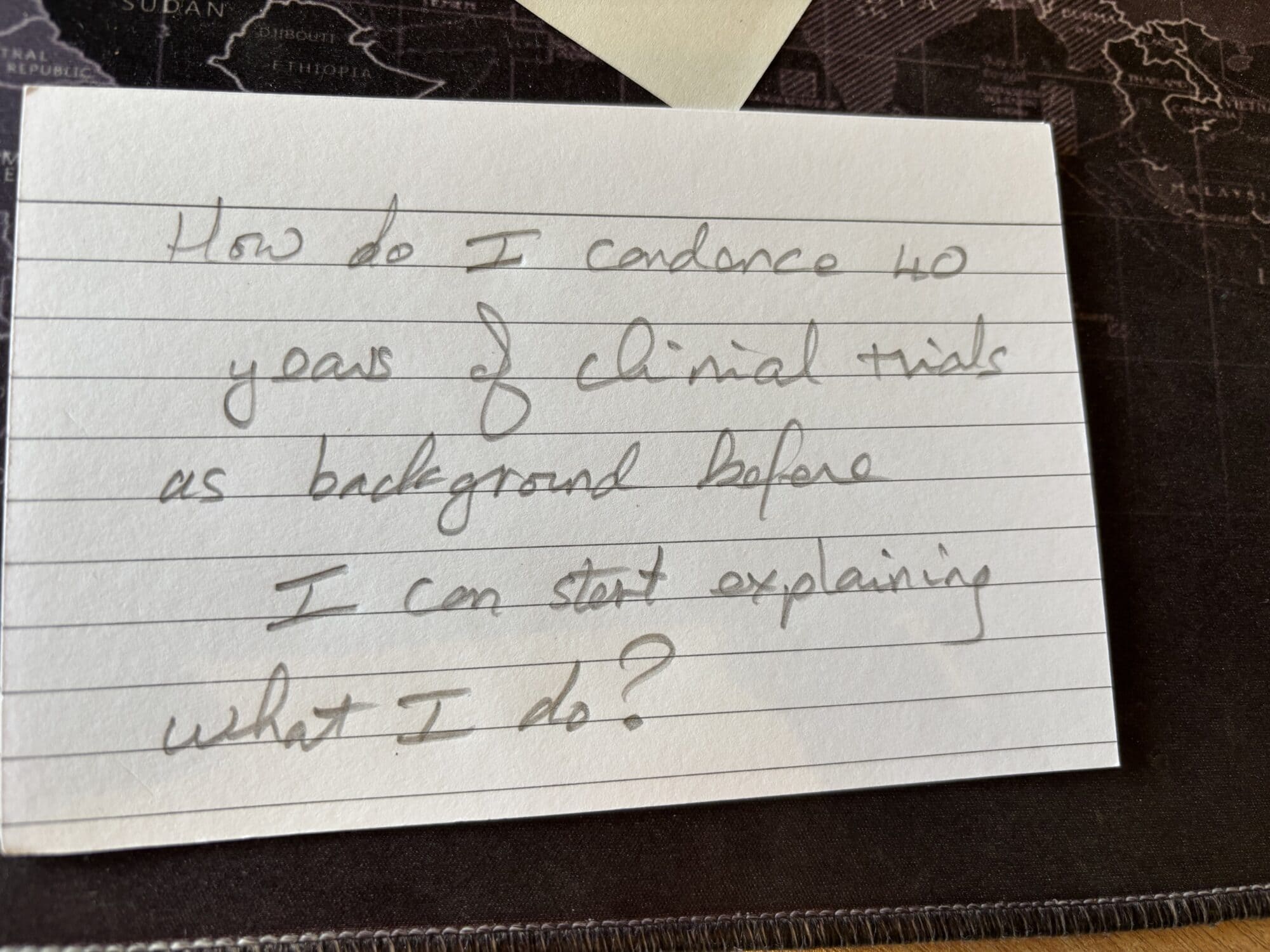
I often start workshops asking people to put specific questions they have on an index card so I can customise the session. I recently got asked by a Life Science start-up “how best can I condense 40 years of clinical data which …”
Long story short… analogies!
People don’t need (or want, but that’s another story) the gory details. They need to know two things that the details are there and they could get them if the wanted them; and to “get” the bigger picture.
For example in a simple presentation no one needs the full data analysis of market options about how many taxi-cabs there are in a town… What they need is an analogy that “Uber is like AirBnB, but for taxi-rides”.
That’s it… your audience will get it from something like that. If they don’t like it, that’s it. If they DO get it, that’s when you hand out the hardcopy with your detailed numbers on.
Yes, it’s more complicated than I’ve made it sound, but not as much as most people want to make it. 😊 The knack lies in finding an analogy that close enough for the audience (not you, the speaker!) and which is:
❗universally known about; and
❗well regarded — it’s not going to help your cause if most people don’t like the organisation you’re using as reference.
There’s a great phrase you can use here that I’ve already mentioned. Is Like But. …as in “What I sell is like X, but different because Y” or “What I do is like X but for Y type people”.
Used early in a funding pitch it’s a powerful tool.
✨ Star Wars is like an old fashioned western, but set in space
✨ Uber is like airBnB but for lifts
✨ Cortisol is like adrenaline but for the brain.
✨ My swimsuits are like Gucci but you can tan *through* them!
So… you know what’s coming… what do you do that’s like something everyone knows but different (better) because…?
